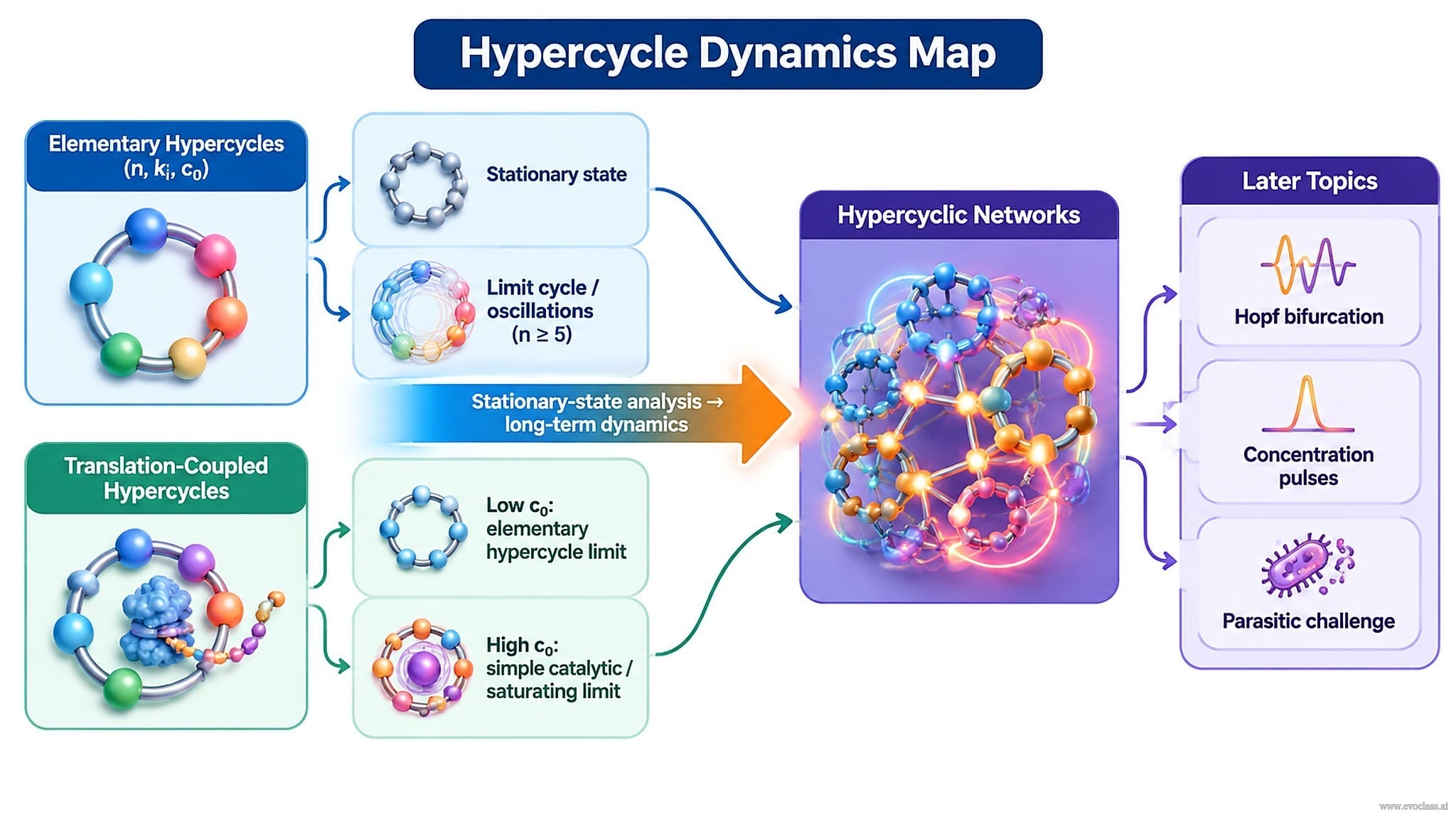
This section marks the shift from fixed-point analysis of hypercycles to their long-term dynamical behavior. Stationary states describe possible equilibria, but selection and evolution are not generic properties of matter; they emerge only when specified catalytic, autocatalytic, and hypercyclic kinetic properties are present.
Why Stationary-State Analysis Is Not Enough
Fixed-point analysis identifies central and corner equilibria in the concentration simplex. Local stability tells us whether small perturbations decay or grow near an equilibrium. It does not, by itself, determine the asymptotic fate of a hypercycle: a locally stable fixed point can coexist with other attractors, and a fixed point can lose stability as parameters change.
Elementary Hypercycles: Stationary States vs Limit Cycles
An elementary hypercycle is controlled by its dimension n, its rate constants
Translation-Coupled Hypercycles
Translation-coupled hypercycles add coupling between polynucleotide replication and polypeptide synthesis, including complex formation and association constants. In the low-concentration limit, they approximate elementary hypercycle behavior. In the high-concentration or saturating limit, the effective dynamics can reduce toward simple catalytic-cycle behavior. This regime dependence is central: the same network can look hypercyclic or merely catalytic depending on c0.
From Local Equilibria to Global Attractors
The qualitative dynamics are therefore shaped by n,
Conceptual pivot
Selection-like behavior is not automatic. It appears only when the kinetic architecture supports autocatalysis, catalytic closure, and hypercyclic coupling. Stationary states are possibilities; limit cycles, pulses, and regime changes are outcomes.
This transition motivates later analysis of limit cycles, Hopf bifurcation, critical slowing down, concentration pulses, and parasite/integration limits.
Hypercycle Dynamics Map
Concept map showing elementary hypercycles branching into stationary states and limit-cycle oscillations for